Hopping Clouds

  • Home
  • About
    • About Me
    • Collaborate
  • Destination
    • Malaysia
    • Singapore
    • Indonesia
    • Hong Kong
    • Taiwan
    • China
    • Japan
    • South Korea
    • USA
  • Food
  • Fun Stuff
  • Say Hi
Powered by Blogger.
Waking the guys up at 3.30am is no joke. With lots of swearing, I managed to roll them out of bed.

We met up at the reception just before 4 am for the Borobudur sunrise tour. Staying at the hotel gives us the advantage of avoiding the crowds by a special pre-dawn stroll through the hotel grounds and right up the UNESCO monument. Upon signing up at the counter, we were given a sticker to show that we came from the hotel and torch. Our guide for the day was Pak Fatah. A French lady joined us in our little tour.

The mist enveloped us as we walked along the trail to the entrance. Pak Fatah started his narration of the monument and how he came to be a tour guide. Before the hotel was built and the surrounding areas being designated as part of the UNESCO site for protection, he used to stay at the village that is right next to the ancient compound. When he was young, he didn't understand the hubbub about this temple. Tour buses used to deposited tourists right at the foot of the building.

The village has been there for ages. The temple was his playground. The village children found the place as an amazing place for a game of hide-n-seek.Tales were passed from the elders that the villagers used to be the labour force for the temple, centuries ago.

 The Indonesian government, realizing the value of tourism, decided to relocate their entire village. Although there was a tone of regret in his voice, Pak Fatah acknowledged that it was also for the greater good. However, he felt that the compensation could be have been better.
Stone steps leading upwards through the arches of Kala. I took this photo on the way down as the dawn light was too dark
Pak Fatah, although a Muslim, is very knowledgeable about Borobudur and its Buddhist teachings. He explained patiently to us the difference in design in every level. Borobudur was designed to reflect the road to enlightenment.As one discards away worldly needs and desires, the ascending design became simpler, without need of adornment.You can hear the passion about conservation in his voice.
At 5am
The morning mist lifting up
Every stupa had its own Buddha sitting in it.

As Borobudur is located quite near to Mount Merapi, an active volcano, the Borobudur park management has designated each stupa to a park official. When there is news of an eruption, the park official will run to his stupa with a "stupa cover" to secure it before the volcanic ash reaches the temple. The first incident they had with volcanic ash was very costly and time-consuming to clean. Each stone had to be removed, cleaned (vacuumed or jet-sprayed) and replaced.
Sun is coming up at 5.30pm. How many sunrises did this Buddha see since it was carved?
With Buddhas surrounding the main stupa, you would expect the main stupa to have some enormous statue. However, archaeologists found none within. It was just a large empty room. According to Pak Fatah, Buddhist monks have informed him that the room is empty to show that enlightenment. That there was no need for a statue of any sort.
Main Stupa in the back
There are no lions on the Java island. How did this fella end up here?
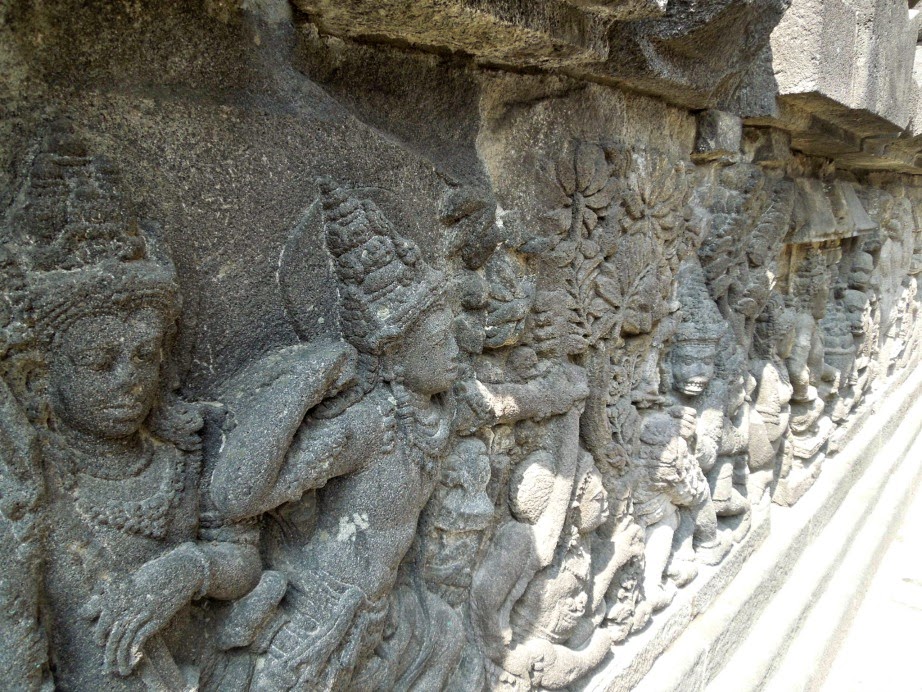
Bas relief depicting Buddha's past lives
The tour ended via another exit directly back into the hotel. That's when my spare shoe gave way. Sigh... of all the things that could have happened.

At the exit, there were lots of souvenir touts who lay in ambush. They are very persistent. Ignoring them would be your best option.

We returned our torch to the counter and received a nice scarf in exchange. Since we were hotel guests, we went to have our breakfast and had our tour snack delivered to us.
Fried banana fritters with cheese. Strange but yummy combination
We checked out after breakfast for the second part of the day's touring. We were headed for cave and river tubing! On the way there, we would make stops at the Pawon and Mendut Temple.

True to his word, Mr. Budi fixed my shoe too!

The Pawon temple lies in between Mendut and Borobudur. It's a small temple and empty inside. Some say it serves as a tomb.
Pawon Temple
We stopped 2km later at Mendut Temple. There was a huge crowd of students on excursions. The strange thing is that they kept trying to speak to us in Japanese O_o. I was tempted to yell back "日本人じゃありません".


They even asked for photos with us. More strangeness.

I couldn't get a shot of the whole temple with the crowd. Mendut Temple is apparently older than Borobudur and it is still being used today. However the conservation on the temple walls are somewhat lacking. 
Mendut Temple
Offering up a prayer
Students on excursion. You can see that parts of the area is still being excavated.
It was a 4 hour drive to Gua Pindul for cave and river tubing after the temples. Unfortunately we not able to capture any photos during the tubing session for fear of dropping our phones into the river. In short, it was a very long journey.

Tubing looks like this, minus the pina colada.
Credits to funny-pictures.picphotos.net
Gua Pindul is generally visited by the locals as a point for river sports. During the wet season, lots of white water rafting is done in this area. Cave and river tubing cost us IDR160,000 each. We started by changing into our swim gear at the rudimentary bath house (around IDR20,000 per entry), getting our tubes and getting an assigned guide.

As we slowly drifted into Gua Pindul, our guide explained the sights to us. In the wet season, cave tubing is usually off limits since water levels could rise dangerously high. There were many rowdy students in the cave doing cliff jumping. Although it was 7 metres to the bottom, our guide cautioned against it as it was still dangerous.

To get to the river tubing portion, we loaded up our tubes into the back of the truck and headed out. The truck stopped us sorta like in the middle of the field and we lugged our tubes down to the river. As it was the dry season, the water currents were really slow and our guide had to pull us along. It was a slow float along the 5km stretch. He told us that the best time to do river tubing is right after the monsoons, around June. Then the swollen river would have receded a little and the currents would be able to push us along at a nice steady pace.

We did a quick kampung style shower after tubing i.e. using a bucket and scooping out frigid water to rinse off the river water. As there is really a lack of space to hang your belongings within the cubicles, best to just put everything into a plastic bag and sort it out later.

For dinner we headed to Yogyakarta for Nasi Gudeg. Mr. Budi brought us to a street in Yogyakarta that specialised in this local dish. We ended up at warung Yu Djum. We sat cross-legged on the floor as Mr. Budi ordered for us.
 
This place seemed quite well-known. Never ending streams of people stopped by to do takeaways.
Nasi Gudeg - boiled jackfruit in coconut milk, boiled egg, buffalo skin, soya cake(tempe) and chicken
Portions were on the small side. It has a sweetish taste to it, probably attributed to the palm sugar involved in the cooking. If you are a big eater, you may need 2 portions of this.

Borobudur Sunrise Tour
Inhouse Price: IDR230,000
Foreign Visitor Price : IDR380,000
Registration : Front desk of Manohara Borobudur Hotel

Gudeg Yu Djum
Address: Kaliurang Street Km 4,5 Karang Asem CT III/22
Tel:+62 274 515968

To be exact it was a 3 days 2 nights trip with my college besties. We have been talking about going on a trip together, just me and the guys, for ages. With the crazy timelines we keep in our careers, we took the leap when a window opened.

Airasia flies directly to Yogyakarta once a day and it takes about 2 and a half hours. The plane was almost empty. That's really rare for a low budget carrier. When the plane landed in Adisucipto, I was surprised at the size of the airport considering that it supported international flights.

There are 2 lines for immigration. Yup, TWO! For ASEAN travelers, a visa upon arrival is not required. However if you are coming in from other countries, there is a small visa counter on your right once you step into the terminal before immigration wooden counters.

The luggage conveyor belt comes after that. At Adisucipto International Airport, its not a luggage carousel. The luggage rolls out and lands with a plop on the floor. Passengers will surge in to grab there bags. If there are a few flights coming in at the same time, it is just mayhem. Try to get there as soon as possible after immigration to avoid someone accidentally taking your luggage away. I tried to take a photo the conveyor belt but every couple seconds or so, someone trying to get to their luggage, would bump into me.

My friends who had arrived 30 minutes earlier were waiting for me outside. Since we live in different countries, we decided to fly in separately and meet upon arrival. Our assigned tour driver, Mr. Budi, was waiting for us patiently. He's a nice, quiet and kind chap (I somehow always find myself with quiet drivers) who practices safe driving.

*short initial review on my tour guide*

If anyone wants a safe, reliable tour operator, contact Borobudur Tours & Travel, Pak Wiedy Antara. He is very professional in handling my multiple changes in itinerary (I blame the indecisive male company of my group),  answered my emails and paranoid questions promptly and basically assured us that everything would be taken care of. I have to admit, I had my reservations based my last experience with a tour/driver agency. Although Borobudur Tours prices are not the cheapest around, but it was definitely worth it.

*end of review*

Since the itinerary has already been sorted out, we headed off to Prambanan Temple - one of the largest Hindu temple complex within South East Asia. On the way there, Mr. Budi put in a call to Pak Wiedy and passed me the phone. Pak Wiedy assured us again that everything was planned and wished us a pleasant time in Yogyakarta.

The Prambanan Temples were half an hour away from the airport. Mr Budi parked the car and led us to a air-conditioned building to meet our guide, a jovial elderly man.When we were ready, he led the way in. We were just in awe.
9th century architecture. How did they get the stones way up there?!
It dawned on us that we would be travelling to UNESCO sites learnt during high school.

There are over 500 temples within the Prambanan Temple compounds and 240 temples at the Prambanan Temple. The 3 main temples within the central compound represent the Trimurthi, dedicated to Brahma (the Creator), Vishnu (the Keeper) and Shiva (the Destroyer).

Our guide told us that we came at the right time as the Shiva Temple had just finished its restoration works from the previous volcano ash debris.Restoration works has been on-going on these 9th century mega structures since 1918. As an earthquake and volcano prone area, the conservation team have to be on their toes to make sure these buildings will continue the test of time and elements. If you see a white dot, that means the stone was not part of the original structure and was placed to replace broken ones.
Interlocking stones
Replacement stones are either obtained the smaller temples destroyed by earthquake or new volcanic stones cut to fit. With the numerous temples and missing parts, the Indonesian government has decreed that only temples with 75% of its original masonry will be restored. Some damage left from the May 2006 earthquake has been left untouched as a reminder that day.
This is supposed to be a mythical creature but it looks like a smiling shih tzu
4 chambers within the Shiva temple house Shiva as Mahadeva, his consort Durga, Agastya and Ganesha. Under the Shiva statue, archaeologists found a well which would provided some sort of water feature for the statue.

In front of the Shiva temple, the Nandi bull, Lord Shiva's vehicle has a temple of its own. Flanking it are the statues of Chandra, the sun god with his 10 horses and Sundra, the moon god on a carriage with 7 horses. The temples housing Brahma's and Vishnu's vehicles, Hamsa (a swan) and Garuda, were empty. I guess looters have a more difficult time moving out a bull that weights a few tonnes.

Bas reliefs depicting scenes from Ramayana covered the temples. It was really like a reading a picture book. The story starts at the east entrance and it goes around clockwise.

Our guide informed us that there were stories about the stone carvers chipping away at their assigned blocks of stone, and there was an inspector who went around checking on the finished work. Any imperfections were discarded and the carvers would have to start over.

He lead us to another temple *ahem* that is more suited to the mature audience. Instead of carvings of heroes, we were presented with scenes of the bedroom and sexual preferences. Passages from the Kama Sutra were etched into the temple walls. I'm not a prude but I didn't think it was right to photoraph veyouristic acts, no matter how old they are or how bizarre. Imagine huge appendages, male-male, male-female, 1 male - multiple females, male with animals. Yup, someone sure had a kinky imagination. PC made a comment that this is an ancient porn manual.
View of the temples from the garden grounds

After the temple tours, our guide lead us through the temple gardens. The shade was welcome after the sweltering heat. The rains had not come for the year. 

We chatted with him as we walked along. Most Prambanan temple guides are not rookies. The guide we were with has been doing this job for the past 15 years! No wonder his presentation and photo skills were good. During our tour there, we saw other guides conversant in Japanese, Spanish and German.

After the gardens, we had to pass by a tourist market to get to the exit. We ignored them and power-walked our way to the exit. Luckily my sneaker sole held out until we reached the entrance. It started coming off when we were climbing up and down the stone stairs at the Prambanan temples.

Mr. Budi was waiting for in the the car. I asked him to stop by a convenience store or something for me to buy super glue. He asked what was the matter and offered to fix my shoe for me. Luck had it that his brother was a cobbler! *thumbs up for Budi!* It was very nice of him to make that offer.

On the way to our hotel, we stopped by a local warung to have lunch. I think it was meant for tourists based on the scenic rice field set behind the dining area and the price it cost. It was still affordable for us but definitely pricey in IDR.

Portions were small and at best I would say that's more of a light in between meal snack rather than a full lunch. We had bebek goreng (it wasn't plucked properly!) fried eel with chili and stir fried kangkong. 

If you see this view, give this eatery a miss.


We proceeded on our 2 hours car ride to Manohara Borobudur Hotel after that.

Borobudur Tour and Travel
Email: http://www.borobudurtourandtravel.com/contactus.php
Contact Person: Pak Wiedy
Price: $$$ (cheaper per pax if more people in a group)
We woke up at 5am to get ready for our hike. We thought it would still be dark like in Singapore but the sun rose very fast in Jeju. By 6.00am we were on the road heading towards Hallasan (한라산). We were worried about weather reports and debated whether to take along our thicker hiking jackets. That morning was predicted to be 3C!

We chose Seongpanak Trail (9.7km) both ways as it was closer to where we were staying. The drive was really lovely but be careful! The roads tend to wind a bit. Some folks may choose the other trail Gwaneusa (8.7km) to descend as it is steeper and a shorter route but that's on the other side of the trail for us. It wasn't worth hitching a ride all the way back to our car.
Seongpanak Visitor Centre
You see the yellow board on the bottom left of the photo above? That's where visitors were supposed to register. Admission is free. If you want to get a certificate for climbing Hallasan, you have to make it back down before 4pm to get the certificate (with your name on it) for around KRW1,000.

Empty your bladder at the Visitor Centre, it's going to be a while before you see the next toilet.


The hiking information board says the first part of the trail is 4.1km. It sure didn't feel like 4.1km. Although a gentle slope upwards, it felt like a 5.5km.


800m only?! This was after half an hour after departing the visitor centre

We reached Sokbat Shelter (toilet break!) after 2 hours of walking. The unusual thing about toilets at the Sokbat Shelter is that it uses bubble foam to flush toilets. This is to conserve water supplies and also keep the smell at bay. There is no food available at this shelter so press on! 

The pine forest greets you after Sokbat.


If you came in spring, this would be a brook


First glimpse at Jindallaebat Shelter. The sun was beating down on us and whatever weather forecast in the morning of of gloomy and cold skies! I started to strip off the layers and continued my hike in a sleeveless T-shirt.

This is the last stop before the last stretch upwards to the peak. You should reach here just before lunch to grab a meal of instant ramen. By the way, the instant ramen tastes awesome during the cold weather. There are no trash bins along the trail there. If you are lucky, you may see some park stuff making their cleaning rounds and you could ask if you can dispose of trash with them. However, hikers are expected to bring their trash down the mountain for disposal. So, pack responsibly!

It's a very Korean experience to eat ramyeon here.
The next part of the trail was much steeper than the earlier parts. I think I over packed by the way. I tend to do that - maybe part of the Girl Guides/Scout training instilled in me to be prepared for anything. I also tend to run into scrapes more often than many other people.

Tall pine trees gave way to low shrubs and then just barren land. Perhaps, spring hasn't really knocked on nature's doors yet. This part of the trail was labelled as the most "difficult" of the hike but given the other hikes I have been on, this is probably a more vigorous romp. I saw many hikers outfitted with sneakers and barely a bottle of water. You can try doing the sneakers but not the water. Seriously, you will need the water.

The stone steps getting taller as you approach the peak. The bare stones and ravens (yes, they are huge) could probably be a set for one of those Alfred Hitchcock movies.


There is only one building manned by a park ranger at the peak. No other shelter apart form that.


We spent an hour soaking in the views and getting our energy up for the hike back down. When we were getting ready to leave, the ravens started cawing loudly. Their caws echoed off the mountains. The park ranger announced (using the PA system mounted to the building) that a storm was approaching and everyone had to get off the mountain. Those who just arrived were turn around immediately and leave. Were the ravens some sort of natural weather system?

We hastened our steps to get in front of the departing crowd.

Sunlight faded at a pretty quick rate and we didn't fancy getting a sprained ankle with all the rocks. We passed a herd of indigenous deer on the way down. Barely visible in the dimming light. I didn't stop to look, I was rock hopping all the way down to reduce the pressure building up in my wonky knee.

When everyone reached the car, we packed and called it a day. Our reward for the climb? Meat.


This trip to Jeju Island is a UNESCO treasure hunt.

When we sorted out the accommodation at Doldam, it was already post lunch. We quickly headed out to a neighborhood restaurant recommended by Su and had the best meal throughout our trip! I'm not exaggerating. Everything was so fresh and the ahjummas were being quite generous in our portions. We were a dead giveaway as first timers to Jeju.
This isn't even the full spread yet!
After our bellies were full with our first Jeju meal, we started up the GPS and made out way to Seongsan Ilchubong Peak (성산일출봉). This is the first on our Jeju UNESCO check off.

Seongsan Ilchubong Peak means sunrise peak and it's the go to place to greet the sunrise for the new year. It's located at the end of the eastern part of the island. We were rushing to make the sunset instead. We were told that the sunset is awfully pretty there.


On our way there we passed fields of rapeseed flowers in full bloom with native ponies wandering around! It looked like a scene out of those travel magazines that makes you wonder whether it has been Photo-shopped. We promised each other that we would definitely have a romp in the fields on the way back.

Seongsan Ilchubong  was formed from under the sea from a volcanic eruption. At the top of the mountain, there a huge bowl like crater. From an aerial view, it looks like an ancient castle. There are a few trails to get to the top of the peak, offering different views. You many not come down the same way you went up so choose wisely.

Luckily for us, the crowds were dwindling when we arrived.  We weren't sure how strenous this walk around the peak would be considering we were going to the highest point on the entire island the next morning. We were very surprised that the Seongsan Ilchubong was quite leisurely considering it was supposed to be a small mountain.


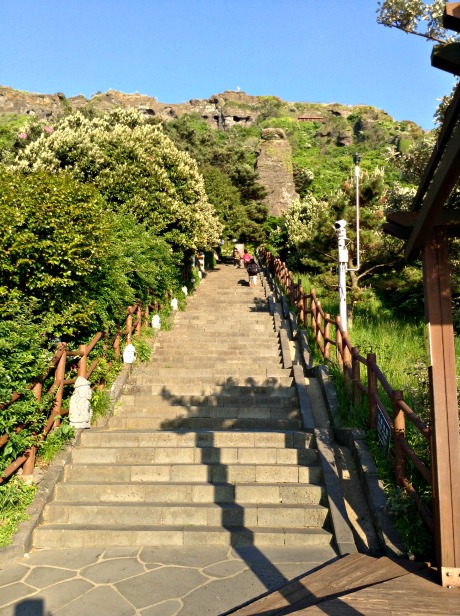
If you want to try your hand at the trails here, I would suggest a decent pair of sneakers. Lots of stairs everywhere.
Dusk is starting to settle

This is the crater at the top of the mountain
On our way down, the hanyeos have left for the day. This cove is where they would collect shellfish and sell to tourists.
It took us about an 1 1/2 hours as we took our time making our way back to our rental car, while enjoying the evening breeze.

We didn't forget the flowers on our way back. I would have loved to have spent more time in the fields if the sun wasn't setting at an extremely fast rate.

Since we would pass Seogwipo, we hopped into a shop selling ox bone soup to fill ourselves up. The winds in Jeju get very strong and cold in the evenings. The ox bone soup really hit the spot. We were actually looking for black pork BBQ but this soup place turned out great!


We wandered around after dinner and bought some breads from the local bakery for the next day's adventure. Most eateries in Jeju has an English menu (including the bakery) so we were quite happy eating our way around.

After the whole day of flying, training, walking and driving, we were tired to our core. We could barely keep our eyes open as we packed our hiking gear for the next day. Not to mention the sound of waves lulled us to sleep in no time.


Seongsan Ilchubung Peak
Address:284-12, Ilchul-ro, Seongsan-eup, Seogwipo-si, Jeju-do
제주특별자치도 서귀포시 성산읍 일출로 284-12
Tel: +82-64-710-7908 /+82-64-783-0959 (Guided tours available)

Admission Fees:  Adults 2,000 won/teens and children 1,000 won


Older Posts Home

ABOUT AUTHOR

Wishing travelling was a full-time job ;)

POPULAR POSTS

  • The Ship @ Damansara Uptown
  • Packing for Pinnacles, Mulu National Park (Prep)
  • Taipei Pig Home Apartment (台北猪窝) @ Taiwan
  • Yan Wo Dou Bun Chong Soya Bean Curd (人和豆品廠) @ Causeway Bay, Hong Kong
  • Hidden Tomato Noodles @ Star Cafe (星座冰室) Tsim Sha Tsui

Categories

Adelaide 4 Australia 3 Bali 7 Books 1 Borobudur 3 Breakfast 5 Brunch 4 Cafe 13 Dessert 1 Food 42 Hiking 19 Hong Kong 4 Hotel 7 Indonesia 11 Jeju 3 Jiu Fen 3 KL 2 Kota Kinabalu 7 Local 1 Malaysia 4 Pinnacles 7 Restaurant 10 Singapore 24 South Korea 4 Taipei 7 Taiwan 12 Travel 57 UNESCO 4 Vietnam 6 Work 3 Yogyakarta 1

Advertisement

FOLLOW ME @ INSTAGRAM

About Me

Popular Posts

  • The Ship @ Damansara Uptown
  • Packing for Pinnacles, Mulu National Park (Prep)
  • Taipei Pig Home Apartment (台北猪窝) @ Taiwan

Advertisement

Copyright © 2016 Hopping Clouds. Created by OddThemes